
Another week, another European flag added to a jackpot provider’s compliance map. On paper, ThrillTech’s new Category A1 Manufacturer’s Licence from the Hellenic Gaming Commission (HGC) reads like routine regulatory housekeeping — the kind of press release that gets skimmed, filed, and forgotten. But look past the formality of the announcement and there’s a more interesting story underneath: a niche technology vendor quietly becoming the template for how modern iGaming suppliers build regulatory moats, one jurisdiction at a time.
ThrillTech has just become the first specialist jackpot provider to secure a licence in Greece, clearing the way for its flagship product, ThrillPots, to go live with regulated operators in the market. It’s a modest-sounding milestone. It’s also a useful lens for understanding where supplier-side compliance strategy in iGaming is headed — and why “boring” back-end licensing news deserves more attention from operators, investors, and competitors than it usually gets.
The Announcement, Stripped Down
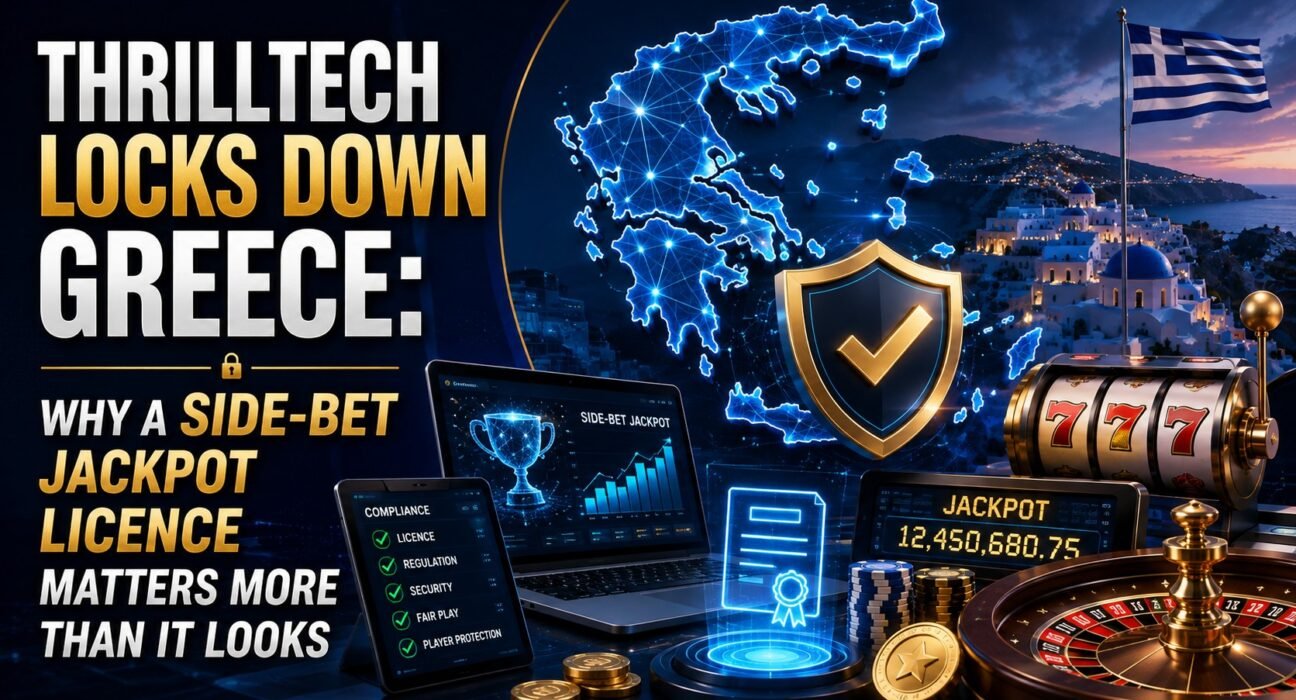
ThrillTech confirmed it has been granted a Category A1 Manufacturer’s Licence by the HGC, Greece’s iGaming regulator. The licence permits the company to supply ThrillPots — its side-bet jackpot product — to operators holding their own Greek gaming licences. Giles Potter, ThrillTech’s Chief Marketing Officer, framed the approval as a first-mover milestone, positioning ThrillTech as the earliest specialist jackpot supplier to clear Greek regulatory hurdles, and describing the company’s ambition to prove that its side-bet mechanics can lift player engagement while opening a new revenue line for operator partners.
That’s the topline. The more instructive detail sits in how ThrillTech structured the deal from a compliance perspective: it secures its own licences and certifications independently of any operator relationship, because its jackpot technology sits entirely outside the core casino or betting product it’s bolted onto.
That architectural choice — independence from the base game — is the whole ballgame here, and it’s worth unpacking before getting to what Greece specifically means for the company and the wider market.
What a “Side-Bet Jackpot” Actually Is
For readers outside the game math weeds, it’s worth being precise about what ThrillPots is and isn’t, because the distinction is the entire reason this licensing story exists in the first place.
A side-bet jackpot is exactly what it sounds like: an optional additional wager, sitting alongside a player’s normal bet on a slot, table game, or sportsbook market, that gives them a shot at a separate jackpot prize. Crucially, the side bet doesn’t touch the underlying game’s mathematics. The RTP of the base slot or the odds on the sportsbook market are untouched. The jackpot has its own, operator-defined RTP, funded by the pool of side-bet stakes from players who’ve opted in, and resolved by an independent random number generator that ThrillTech owns and operates.
This “bolt-on, not built-in” design is what allows ThrillTech to pursue its own certifications rather than relying on downstream operators to vouch for its compliance. Because the RNG and the jackpot logic are self-contained, regulators can assess and certify ThrillTech’s system as its own discrete product — much like a payment processor or a KYC vendor gets its own approvals, rather than being certified only as an extension of whichever casino brand happens to be using it.
That matters commercially for two reasons. First, it means ThrillTech can walk into any regulated market and make its case directly to the regulator, rather than waiting for an operator partner to sponsor the process. Second, and more importantly for the read-through here, it means every new licence ThrillTech collects is a reusable asset — proof of a working compliance framework it can point to the next time it walks into a new jurisdiction’s application process.
Why Greece, and Why Now
Greece isn’t the flashiest market on the European iGaming map, but it’s a genuinely useful one for a jackpot supplier to have in the portfolio, for a few reasons.
It’s a real, sizeable regulated market with real operators. Greece formalised its online gambling regime years ago under the HGC’s oversight, and the market has settled into a mature, if tightly controlled, regulatory posture. A meaningful roster of licensed online casino and betting operators are active in the country, which means ThrillTech isn’t securing a licence to sit on a shelf — there’s an addressable base of potential integration partners already live and generating player volume.
It’s a market where regulators take game-level scrutiny seriously. The HGC has a reputation, common among the more mature Southern and Eastern European regulators, for close technical review of gaming products — RNG certification, RTP disclosure, responsible gambling controls, and audit trails all get real attention rather than rubber-stamp treatment. Clearing that bar isn’t nothing. A licence from a regulator known for rigour is a stronger compliance signal to show the next regulator in the queue than one from a lighter-touch jurisdiction would be.
It rounds out a specific kind of European coverage. ThrillTech’s existing licensed and certified footprint already spans the UK, Sweden, the Netherlands, Romania, Malta, and — most recently before Greece — Gibraltar. That’s a deliberate mix: it covers Western Europe’s most established markets (UK, Netherlands), the Nordics’ stricter consumer-protection regime (Sweden), Malta’s role as the industry’s operational and licensing hub, and newer entrants in Central/Eastern Europe (Romania). Greece slots into the “mature Southern European” gap in that map. Taken together, the company can now credibly tell prospective operator partners that its product runs, certified, across most of the regulatory archetypes found in the EU and adjacent European markets.
Timing lines up with market appetite for engagement mechanics. Regulated European operators are under constant pressure to lift player engagement and lifetime value without leaning on the kind of aggressive bonusing that increasingly draws regulatory attention. Side-bet jackpots are one of a handful of mechanics — alongside gamification, loyalty tiers, and tournament formats — that operators can deploy to boost stickiness without touching bonus wagering requirements or altering core game RTP, both of which are hot-button compliance issues in markets like Sweden, Germany, and increasingly Greece itself. A product that adds engagement without adding regulatory risk is an easy sell to compliance-conscious operator teams right now.
The Bigger Pattern: Jackpot-as-a-Service Goes Multi-Jurisdictional
ThrillTech isn’t inventing the side-bet jackpot category — progressive and networked jackpot mechanics have existed in regulated gambling for decades, largely bundled into slot content from major studios or run as proprietary features by individual operators. What’s shifted, and what this Greek licence is really evidence of, is the emergence of jackpot technology as a standalone, licensable, cross-operator infrastructure layer — closer in structure to a payments processor or an odds-feed provider than to a traditional slot studio.
That shift has a few consequences worth watching.
It changes who competes with whom. A specialist jackpot vendor operating this way isn’t just competing with other jackpot mechanics baked into slot content by the big studios. It’s competing with every other “engagement layer” a compliance team has to evaluate, certify, and integrate — tournament platforms, gamification suites, loyalty engines. The pitch to operators becomes: plug in a jackpot layer the same way you’d plug in a loyalty platform, without re-engineering your existing game catalogue.
It raises the compliance bar as a competitive weapon. Once one vendor in a niche demonstrates it can secure direct regulator sign-off, market by market, independent of any single operator relationship, it puts pressure on rivals to either match that footprint or risk being seen as a heavier compliance lift for operator partners. In a sector where legal and compliance teams increasingly have an effective veto over new supplier relationships, “already licensed in your market” is a shortcut that shortens procurement cycles considerably.
It rewards suppliers who treat licensing as core R&D spend, not overhead. Every jurisdiction has its own RNG testing standards, RTP disclosure rules, and responsible gambling requirements. Building a product architecture that can be certified repeatably across those variations — rather than reworked from scratch each time — is genuine technical and legal work. Vendors who invest early in that repeatability compound the advantage: the fifth licence is cheaper and faster to secure than the first, because the underlying certification playbook already exists.
What Greek Operators Actually Get
Strip away the vendor talking points and ask what a licensed Greek operator gains by integrating ThrillPots. In principle, three things:
- A new, ring-fenced revenue stream. Because the jackpot RTP is separately defined from the base game, operators can calibrate the side-bet economics independently — setting hold rates and jackpot funding levels without touching the RTP disclosures already certified for their core slot or table content.
- An engagement mechanic that doesn’t require menu-wide game replacement. Side-bet jackpots layer onto existing games rather than requiring operators to swap out slot content or renegotiate studio deals, which lowers the operational lift of adoption considerably compared with, say, migrating to a new game aggregator.
- A compliance story that’s already been vetted. Because ThrillTech carries its own HGC-approved certification into the relationship, the Greek operator’s own licensing renewal and audit conversations get simpler — they’re integrating a product the regulator has already reviewed on its own technical merits, rather than asking the regulator to evaluate an entirely novel mechanic bundled inside a broader game submission.
None of that guarantees commercial success, of course. Player appetite for side-bet jackpots varies by market and by game type, and operators will still need to test placement, pricing, and marketing of the feature to see whether it moves the retention and ARPU needles the way ThrillTech’s marketing suggests it can elsewhere. But the friction to trying it out is measurably lower than it would be for a less independently certified product.
The Americas Angle: A Company Building Two Playbooks at Once
It’s worth noting that Greece isn’t ThrillTech’s only recent expansion. The company’s licensed and certified footprint also extends into Brazil, Peru, and the Canadian province of Ontario — three markets with wildly different regulatory philosophies from each other, let alone from the EU bloc where Greece sits.
Brazil’s newly regulated sports betting and igaming market is still working through its early licensing cycles, with regulators actively defining technical standards in close to real time. Ontario’s AGCO-run model is one of North America’s most mature single-jurisdiction regulated markets, with an established, iGaming Ontario-run registration process that most global suppliers now treat as a baseline credential. Peru sits somewhere in between — a market still building out its full regulatory apparatus for online gambling.
Running compliance simultaneously across the EU’s more prescriptive, harmonisation-influenced framework and the more fragmented, jurisdiction-by-jurisdiction Americas model is a genuinely demanding operational task for a mid-sized specialist supplier. It suggests ThrillTech isn’t treating international expansion as a single template rolled out repeatedly, but as two (at least) distinct regulatory playbooks running in parallel — one built for Europe’s licensing regimes, one for the Americas’ more varied, faster-evolving frameworks.
For a company of ThrillTech’s size and category focus, that’s an ambitious posture. It’s also a fairly reliable signal of how seriously the company is taking global scale as a strategic priority, rather than opportunistically chasing whichever market happens to be easiest to enter next.
The Skeptic’s View
It would be an incomplete piece if it didn’t include the obvious pushback a market-watcher should raise here.
First: a manufacturer’s licence is a necessary condition for market entry, not a guarantee of commercial traction. ThrillTech now has the legal right to sell ThrillPots into Greece. It still needs to convert that right into actual operator integrations, actual player uptake, and actual revenue — none of which is assured just because the HGC signed off on the RNG.
Second: “first specialist jackpot provider licensed in Greece” is a claim about category positioning, not necessarily about being first to market with jackpot mechanics in Greece generally. Slot studios and platform providers have long bundled their own jackpot features into content already live with Greek operators. ThrillTech’s distinction is being first as an independent, standalone specialist in this exact niche — a real point of differentiation, but a narrower one than the marketing framing might suggest at first read.
Third: side-bet jackpots as a category still face an open question around long-term player reception. They’ve proven durable in some markets and quietly discontinued in others, depending on how well operators calibrate visibility, pricing, and integration into the player journey. A licence clears the regulatory path; it doesn’t pre-answer the product-market fit question.
None of that undercuts the genuine strategic logic of the expansion — it’s just the context that separates a press release from an investment thesis.
What to Watch Next
For anyone tracking the supplier side of the European iGaming market, a few markers are worth keeping an eye on following this announcement:
- Which Greek operators actually integrate ThrillPots first, and on what kind of game content — slots, live casino, or sports betting side markets — will tell you more about real-world traction than the licence itself does.
- Whether ThrillTech announces further European jurisdictions in the near term. The company’s stated pattern of jurisdiction-by-jurisdiction expansion, combined with its now-broad European base, makes further announcements — Spain, Italy, or Denmark, for instance — a reasonably likely next chapter.
- Whether competing jackpot and engagement-mechanic vendors respond with their own licensing pushes in similar markets, which would confirm that direct, operator-independent regulatory certification is becoming table stakes for the category rather than a one-off differentiator.
- How the Americas expansion (Brazil, Peru, Ontario) develops in parallel, since a supplier that can demonstrate credible compliance depth on both sides of the Atlantic simultaneously becomes a meaningfully more attractive long-term partner for multi-market operator groups.
A Quick Word on ThrillTech Itself
ThrillTech has positioned itself, deliberately, as a specialist rather than a generalist — a company built around one core competency (side-bet jackpot mechanics) rather than a broad content or platform catalogue. That’s a meaningfully different business model from the slot studios and full-stack platform providers that dominate most iGaming supplier headlines.
The advantage of specialism, when it works, is depth: ThrillTech can pour its engineering, compliance, and commercial resources into perfecting one mechanic and one certification pathway, rather than spreading them across dozens of game titles or a sprawling platform roadmap. The risk of specialism is concentration: the company’s fortunes rise and fall with demand for one category of product, in a market where operator attention spans and feature trends can shift quickly.
What the Greek licence — alongside the UK, Sweden, Netherlands, Romania, Malta, Gibraltar, Brazil, Peru, and Ontario approvals already on the books — demonstrates is that ThrillTech is betting heavily on geographic diversification as the hedge against that concentration risk. Rather than diversifying its product line, it’s diversifying the number of regulated markets in which a single, well-understood product can be sold. That’s a coherent strategy, and one that plenty of infrastructure-style suppliers in adjacent industries (payments, KYC, odds compression) have used successfully to scale before eventually broadening their product suites from a position of established trust.
Context: How the Side-Bet Category Got Here
It’s easy to assume side-bet jackpots are a recent invention, but the underlying concept — an optional, separately-priced wager layered on top of a primary game, resolved independently of that game’s core outcome — has precedent stretching back to physical casino floors, where progressive jackpot side bets on table games like Caribbean Stud and Ultimate Texas Hold’em have existed for decades, typically administered under the casino’s own gaming licence rather than a third party’s.
What’s changed in the online environment is the unbundling of that mechanic from the operator itself. In a physical casino, the operator holds the licence for everything happening on the floor, side bets included. Online, regulators have increasingly been willing to license specific technical components — RNGs, payment rails, verification tools — to third-party vendors directly, rather than insisting every certification route runs through the operator holding the primary licence.
That regulatory willingness to license discrete technical components is really the enabling condition for ThrillTech’s entire business model. It’s also, not coincidentally, a broader trend across iGaming supply chains: modularity. Operators increasingly assemble their product stack from specialist, independently-certified vendors — one for payments, one for KYC and AML screening, one for odds feeds, one for player analytics — rather than relying on a single monolithic platform provider for everything. Jackpot mechanics becoming their own certifiable, licensable category fits neatly into that broader unbundling of the iGaming tech stack, and Greece’s approval of ThrillTech is a small but clear data point confirming that regulators are comfortable extending that modular approach to jackpot RNGs specifically.
The Bottom Line
A Category A1 Manufacturer’s Licence from Greece’s gaming regulator isn’t, by itself, a headline-grabbing event. But it’s a clean example of how supplier-side compliance strategy has quietly become one of the more important competitive fronts in modern iGaming — arguably as consequential to a specialist vendor’s growth trajectory as the underlying product itself.
ThrillTech’s bet is that by keeping its jackpot technology architecturally independent from any single operator’s core game math, it can build a repeatable, exportable compliance framework — one that turns each new market entry into leverage for the next, rather than a one-off project. Greece is the latest data point in that strategy, not the culmination of it. Whether ThrillPots becomes a meaningful revenue line for Greek operators is still an open, and separate, question — but the company has clearly decided that answering the compliance question first, market by market, is the only way it wants to find out.